Buyer taste shifts every year. The colour palettes, materials and layouts that moved properties in 2024 are not the same as the ones working in 2026. This annual report covers the trends professional stagers across Kent, Sussex and Surrey are seeing land with UK buyers right now.
For the evergreen method behind staging itself, see the art of home presentation for sale. What follows is what is working in 2026 specifically.
What are the home staging trends for 2026?
The biggest 2026 home staging trends in the UK are warm earth-toned palettes replacing cool greys, mixed-material kitchens, biophilic touches in every room, oversized soft seating, layered textile-led bedrooms, statement-but-restrained lighting, and energy-efficiency cues that signal lower running costs. The era of cold minimalism is over; warm minimalism is winning.
This is not a complete redesign trend. It is a shift in accent: the staging method stays the same, the colour and texture choices update.
Which colour palettes are winning in 2026?
Warm neutral palettes built around buttermilk, oat, terracotta, soft clay and warm taupe are outperforming the grey-and-white schemes that dominated the late 2010s. Buyers in 2026 are reading cool greys as dated and corporate; warm neutrals read as homely and current.
The 2026 staging palette:
| Application | 2024 winner | 2026 winner |
|---|---|---|
| Walls | Cool grey | Buttermilk, oat |
| Kitchens | White and chrome | Cream and brushed brass |
| Living room accents | Navy, mustard | Terracotta, sage |
| Bedrooms | Soft white | Warm linen tones |
| Bathrooms | Crisp white | Off-white with stone accents |
Bold colour still has a place, used sparingly. A single artwork or a styled vase in a saturated tone reads as confidence; a full bold-painted wall reads as someone else’s taste.
What materials are buyers responding to?
UK buyers in 2026 respond strongly to natural materials: oak, linen, ceramic, wool, stone and brushed brass. Synthetic-looking finishes (high-gloss laminate, chrome hardware, cool plastic) are reading as cheap. Mixed-material kitchens (oak base units with stone tops and brass handles) outperform monolithic gloss kitchens in viewings.
The materials hierarchy:
- Up: Oak veneer, linen upholstery, ceramic vessels, wool throws, stone surfaces, brushed brass, rattan accents.
- Down: High-gloss white laminate, chrome handles, cool acrylic, polished steel, faux velvet.
- Holding steady: Quality leather, cotton bedlinen, real wood floors, marble (used sparingly).
This shift affects styling decisions more than structural ones. Stagers can change perceived material quality with cushion swaps, throw choices and tabletop accessories without touching the actual fixtures.
How are biophilic design touches showing up?
Biophilic design – bringing nature indoors – is the strongest staging trend of 2026 because it photographs well and signals wellbeing without specialist installation. The most effective touches are large indoor plants in floor-standing planters, fresh-cut greenery in vases, dried-grass arrangements, natural fibre rugs and unobstructed views to the garden.
Practical biophilic staging in 2026:
- One large statement plant per main room. Fiddle leaf fig, monstera, kentia palm.
- Fresh-cut greenery in the kitchen. Eucalyptus or olive branches in a tall vase.
- Dried grass arrangements. Pampas, wheat, lavender stems for warmth without watering commitment.
- Open garden views. Clear blinds and curtains fully on garden-facing windows.
- Natural-fibre rugs. Jute, sisal, wool over synthetic options.
Biophilic staging suits both occupied and empty properties. The cost is small (£100-£300 across a whole house) and the visual return is high.
What is happening with lighting in 2026?
Statement-but-restrained lighting is the 2026 winner: one strong fixture per room, often oversized for the space, paired with warm consistent ambient lighting throughout. The era of multiple matching ceiling spots is fading; sculptural pendants, wall sconces and floor lamps in brass, ceramic or rattan are taking their place.
The practical lighting moves for 2026:
- One sculptural pendant in dining and kitchen spaces. Rattan, ceramic or brushed brass.
- Oversized floor lamps in living rooms. Visible statement piece, soft warm bulb.
- Layered bedroom lighting. Bedside table lamps, plus a wall sconce or a small floor lamp.
- Consistent 2700K bulbs throughout. Mixed temperatures hurt photographs.
- No more ceiling spotlights as the only light source. Reads as commercial.
Lighting is the staging move with the highest impact-per-pound after cleaning and decluttering.
Which kitchen and bathroom looks are selling in 2026?
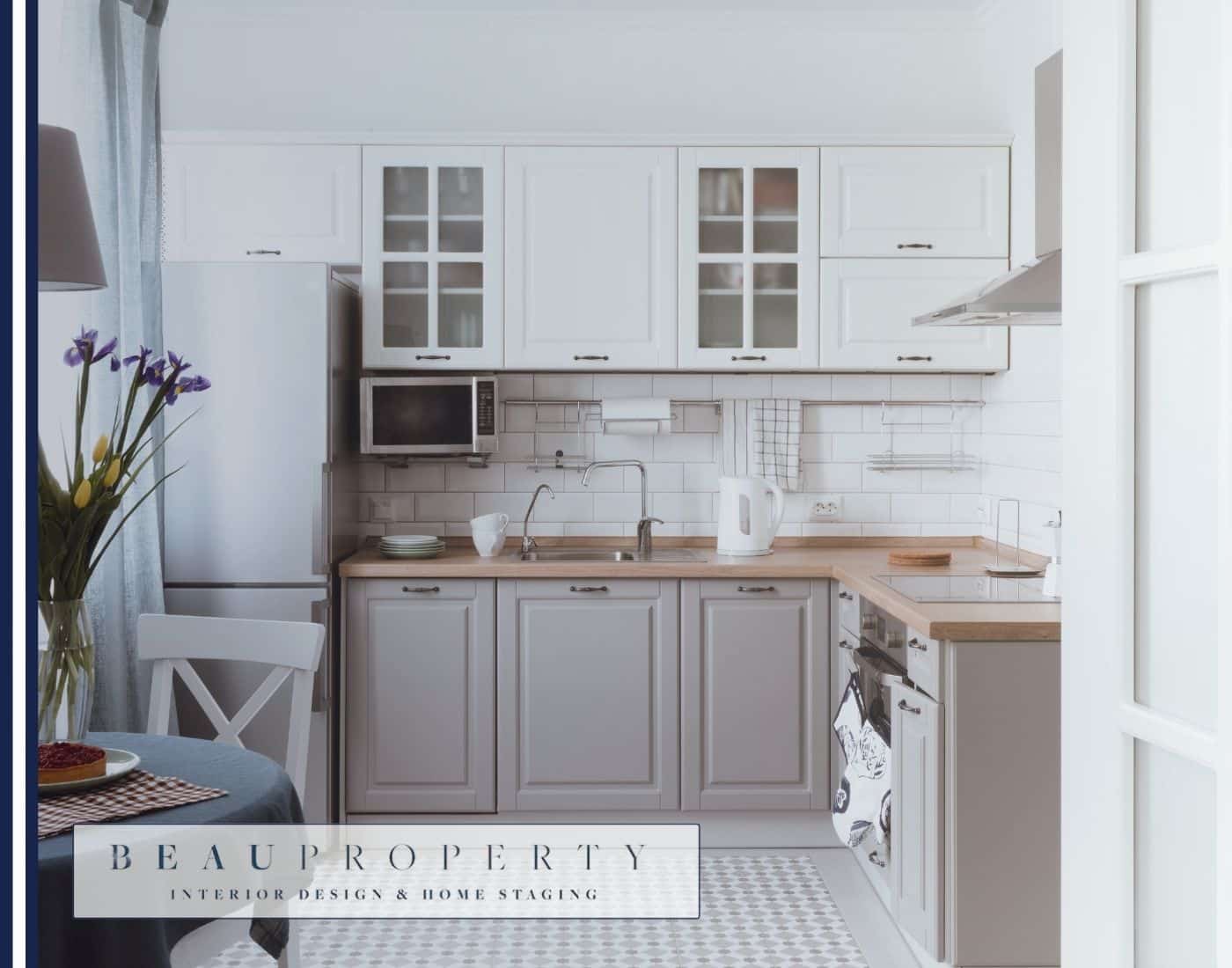
UK kitchens that sell in 2026 mix materials, tone down white-and-chrome dominance, and feature visible storage solutions (open shelves, plate racks, woven baskets) over hidden cabinetry only. UK bathrooms that sell mix stone and tile rather than full white tile, use freestanding basins where possible, and lean on soft warm lighting over harsh ceiling spots.
The kitchen shift:
- Cream or oak base units replacing gloss white.
- Stone or quartz worktops in warm tones replacing cool whites.
- Brushed brass or matte black hardware replacing chrome.
- One open shelf displaying styled ceramics replacing all-closed cabinetry.
- Woven baskets visible for warmth.
The bathroom shift:
- Stone-effect tiles replacing pure white tile in showers and floors.
- Freestanding basins replacing built-in vanities.
- Brushed brass or matte black taps replacing chrome.
- One large statement plant.
- Backlit mirrors replacing fluorescent strips.
For room-specific styling detail, see the bathroom staging guide.
What 2026 trend should you ignore?
Maximalism is the 2026 trend most likely to hurt UK property sales. Pinterest, Instagram and design magazines are pushing layered patterns, bold colour walls and dense displays, but on a sale property these narrow the buyer pool. Reserved warm minimalism wins viewings; maximalism photographs beautifully and sells less reliably.
Other trends to use carefully or ignore for sale:
- Smart-home tech as a feature. Buyers do not care; some find it intimidating.
- Statement wallpaper. Polarising. Beautiful but narrows appeal.
- Bold ceiling colours. Trending in interiors content; fails on sale.
- Open shelving in every room. Looks great styled by professionals; reads as cluttered when lived-with.
- Dark moody bedrooms. Atmospheric, but small bedroom + dark walls = tiny.
Trend awareness is useful. Trend chasing on a sale property is not.
Frequently Asked Questions
Should I update my home’s decor to match 2026 staging trends?
You should update accent items – cushions, throws, vases, art, plants – to match 2026 trends if you are selling within the next six months. You should not undertake major redecoration purely for trend reasons; the cost rarely returns versus simply staging well with broadly neutral choices. Focus on the colour palette and material shifts that need only soft-furnishing changes.
How long do home staging trends last?
UK home staging trends typically run on a three-to-five year cycle for major shifts (palette and material direction) and a one-to-two year cycle for accent details (specific colours, finishes, accessories). The current shift from cool grey to warm neutral has been building since 2023 and is expected to dominate through 2027 or 2028.
Are 2026 trends different across UK regions?
Trends are broadly consistent across the UK, with some regional variation. London and the South East tend to lead on adoption, with the Midlands and North following six-to-twelve months later. Coastal Sussex and Kent properties also benefit from beach-influenced palettes (rope, weathered wood, soft blue accents) that play less well in inland or urban properties.
Will following 2026 trends increase my sale price?
Following 2026 trends will increase the perceived freshness and current-feel of your property in listing photos, which typically improves buyer interest and viewing volume. The price uplift comes from doing the underlying staging work well; trend choices add maybe 1-2% on top of that as a polish factor. The big lifts come from the foundational home staging method, not from trend-chasing.
When will the 2027 trend report be available?
Beau Property Staging publishes an annual UK staging trend report in April each year. The 2027 update will be available in April 2027.
Apply 2026 Trends to Your Sale
Beau Property Staging works with sellers across Kent, Sussex and Surrey using current trend awareness within the proven staging method. To discuss applying 2026 trends to your property, get in touch.
Trend-led styling decisions land differently in different markets. For the regional context shaping how 2026 trends translate locally, see current Sussex, Surrey and Kent property market trends.